DICL User's Manual
This is a simple instruction manual for the Database of Ion Channels and Ligands browser. For more background information, please refer to the corresponding publication. This manual was last updated on March 3, 2026. If you notice any errors or would like to suggest additions, please feel free to contact us.
Table of contents
- 1. Overall Layout
- 2. Database Construction
- 3. Data Types
- 3.1 Targets
- 3.2 Compounds
- 3.3 Peptides
- 4. Browsing
- 5. Search & Download
1. Overall Layout
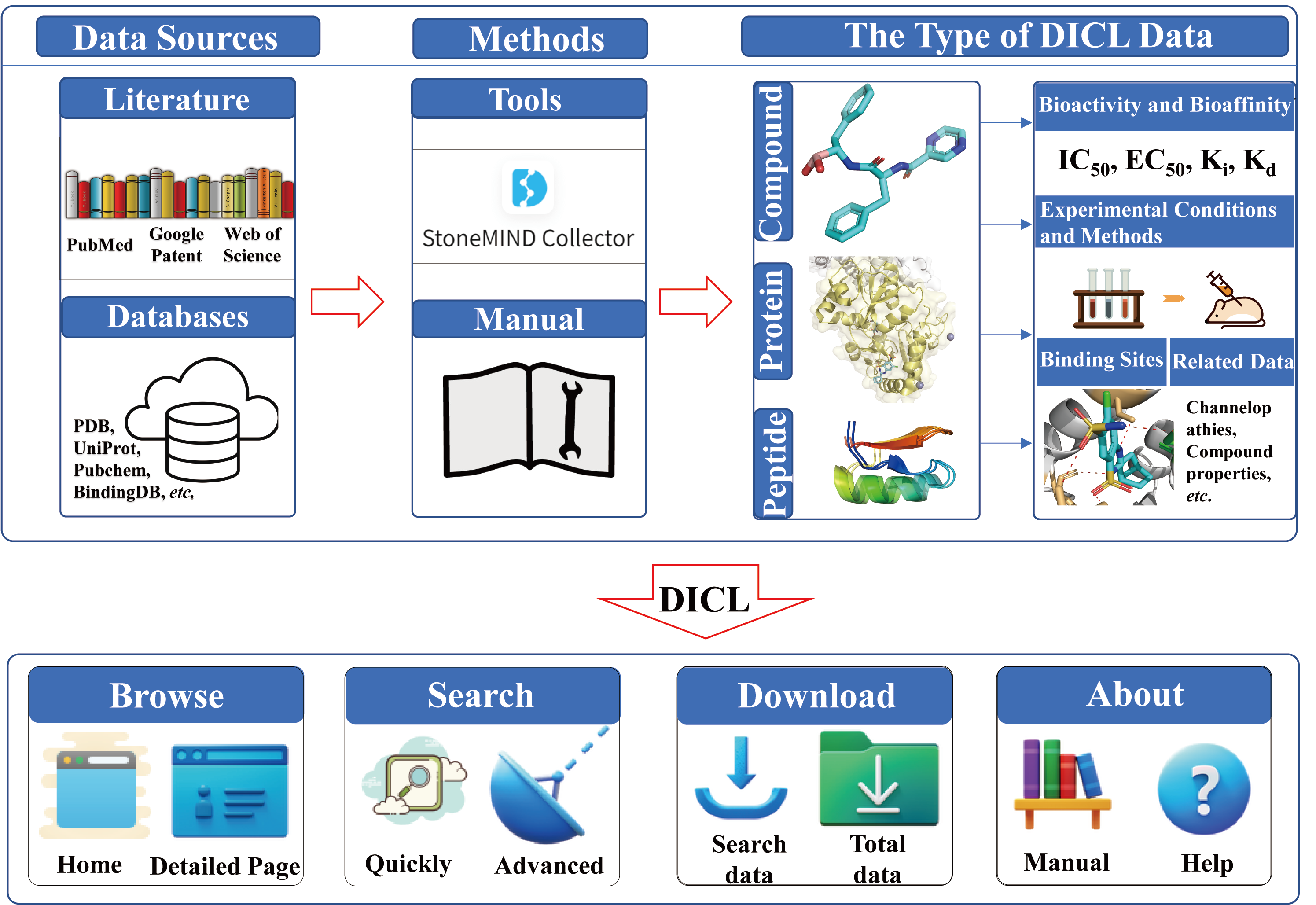
In this work, we developed the DICL, a comprehensive database that encompasses data resources for compounds, peptides, and receptors related to ion channels (Figure 1). Firstly, the database includes 1,750 distinct ion channel proteins, classified into 27 types of ion channels. Furthermore, 462,171 entries of compounds and 7,122 recordings of peptides from over 6,000 peer-reviewed articles or patents were included in the DICL database.
The DICL provides a user-friendly interface for data querying, downloading, and visualization. The DICL is a valuable resource for researchers and scientists interested in ion channel-related drug discovery and development.
2. Database Construction
As shown in Figure 1, The data for DICL were sourced from both literature and publicly accessible databases through manual collection and StoneMIND collector. The tools of RDKIt, Smiles Drawer and 3Dmol.js were utilized to display and calculate molecular properties. First, the collected smile structures are standardized using RDKIT. Then, all SMILES representations of all compounds were manually verified using ChemDraw2019, and the corresponding InChI, InChIKey, and two-dimensional SDF files were generated from the SMILES using RDKit software. Article DOI and PMID information were gathered from PubMed and Web of Science. Furthermore, eight critical properties associated with drug-likeness were predicted and incorporated into DICL. Properties including the number of heavy atoms rings (HAR), hydrogen bond acceptors (HBA), rotatable bonds (RB), topological polar surface area (TPSA), complexity, and hydrogen bond donors (HBD) were calculated utilizing RDKit, whereas logP values were determined using ADMETlab 3.0 software.
Finally, the data were presented on the website (https://fca_icdb.mpu.edu.mo/ICHDB/public/) using mysql, php 8.1.2 and Apapche2 on Unbuntu. At same time, codeigniter4.6, Bootstrap5, Javascript were used to beautify and modify web pages.
3. Data Types
This current version of DICL includes 7,122 activity records for peptides, encompassing 2,195 peptides from 703 references, 150,208 data entries related to 72,420 compounds gathered from 5,960 pieces of literature, 306,894 compounds from hERGCentral database. Additionally, nearly 1,700 distinct ion channel sequences from 175 species have been compiled in DICL.
3.1 Ion Channels
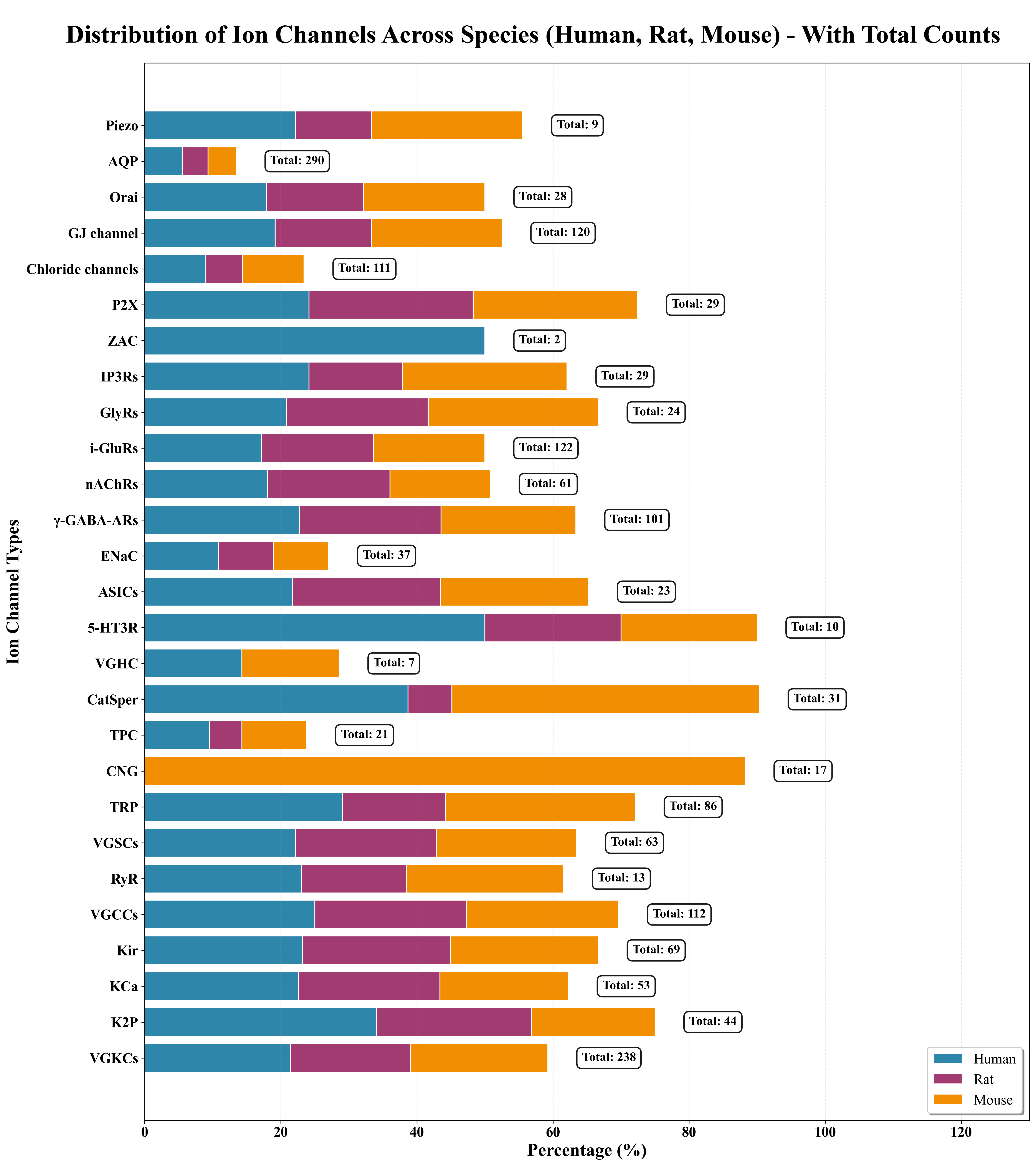
In the DICL, approximately 1,750 distinct ion channel proteins from 165 species are included, which can be classified into 27 different types of ion channels. As depicted in Figure 2, there are 27 types of ion channels across humans, rats, and mice.
3.2 Compounds
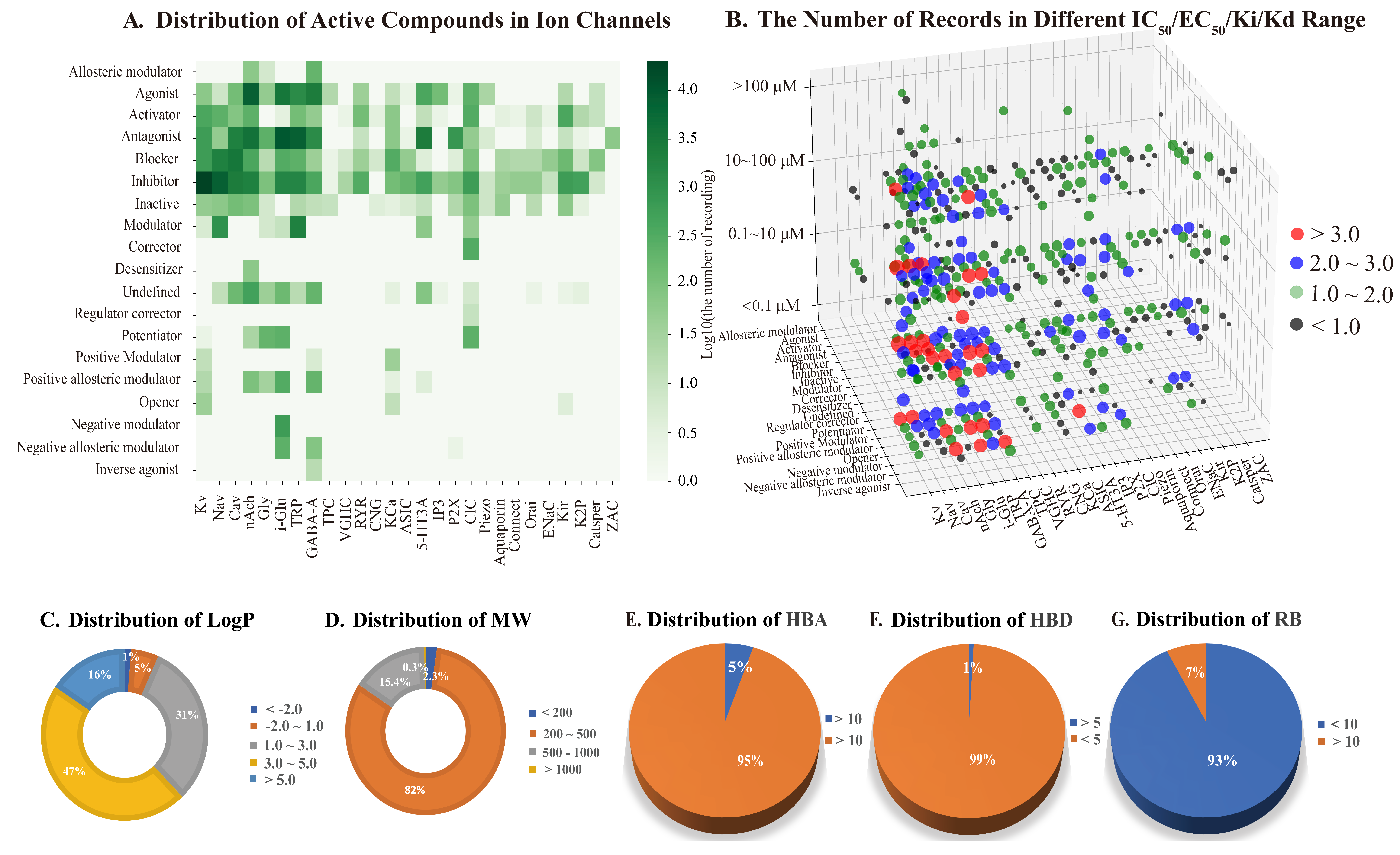
This current version of DICL comprises 150,208 data entries related to 72,420 compounds gathered from 6,000 peer-reviewed literature or patents. Figure 3A illustrates the distribution of active compound for each type of ion channel in the database. In figure 3B, there are four classification, which contains less than 0.1 μM, 0.1 to 10 μM, 10 to 100 μM, and greater than 100μM. The color (red: log(the number of active values)>3, blue: 2<log(the number of active values)≤3, green: 1<log(the number of active values)≤2, black: 1<log(the number of active values)≤2) and size of the circle represent the number of active values logarithmic value. (C) Distribution of active compounds LogP in 27 kinds ion channels. (D) Distribution of active compounds molecular weight in 27 kinds ion channels. (E) Distribution of active compounds H bond acceptor in 27 kinds ion channels. (F) Distribution of active compounds H bond donor in 27 kinds ion channels. (G) Distribution of active compounds rotatable bond in 27 kinds ion channels.
3.3 Peptides
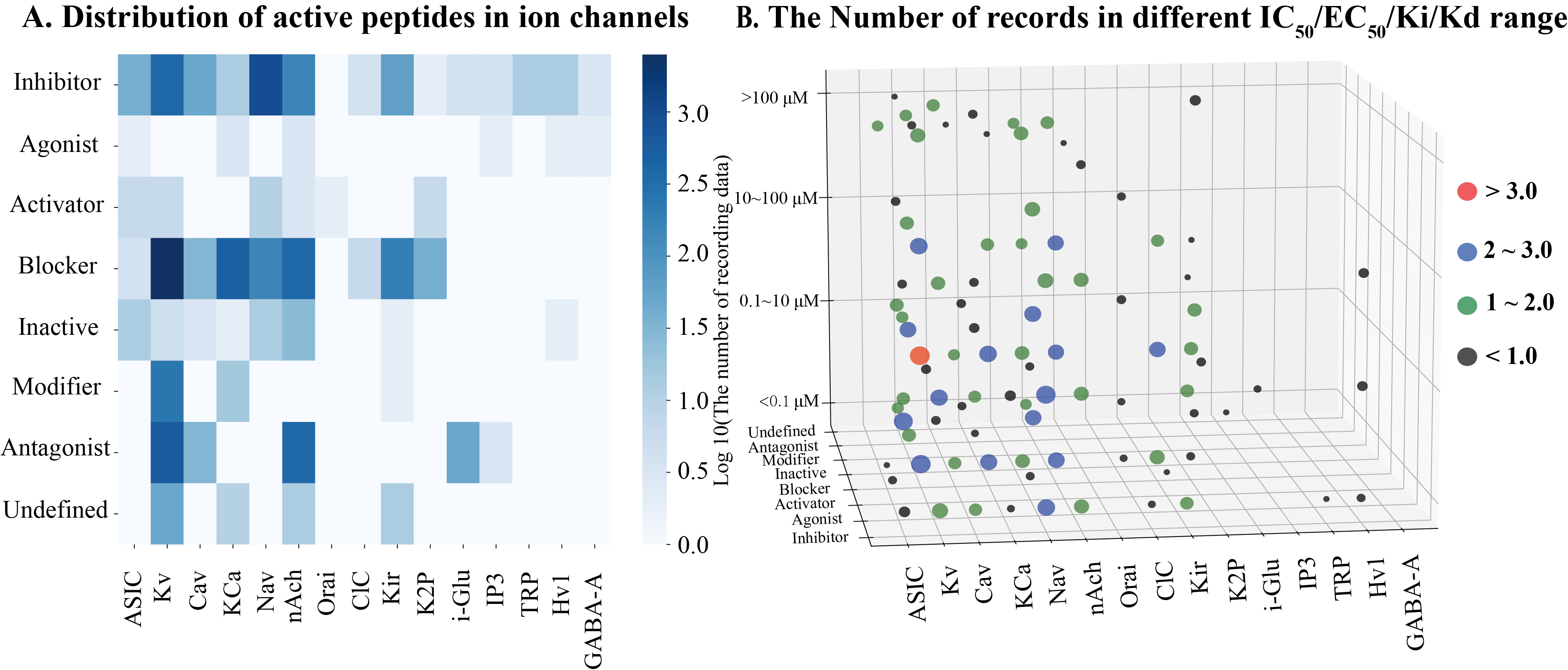
This current version of the DICL documents a total of 7,122 data records for peptides supported by peer-reviewed literature, encompassing 2,195 peptides from 703 references. Figure 4A illustrates the number of peptides interacting with several types of ion channels. In Figure 4B, there are four classifications: less than 0.1 μM, 0.1 to 10 μM, 10 to 100 μM, and greater than 100 μM. The color of the circles indicates the range of active values(red: log(the number of active value)>3, blue: 2<log(the number of active value) ≤3 , green: 1<log(the number of active value)≤2, black: 1<log(the number of active value)≤2). The size of the circles represents the logarithmic value of the number of active values, respectively
4. Browsing
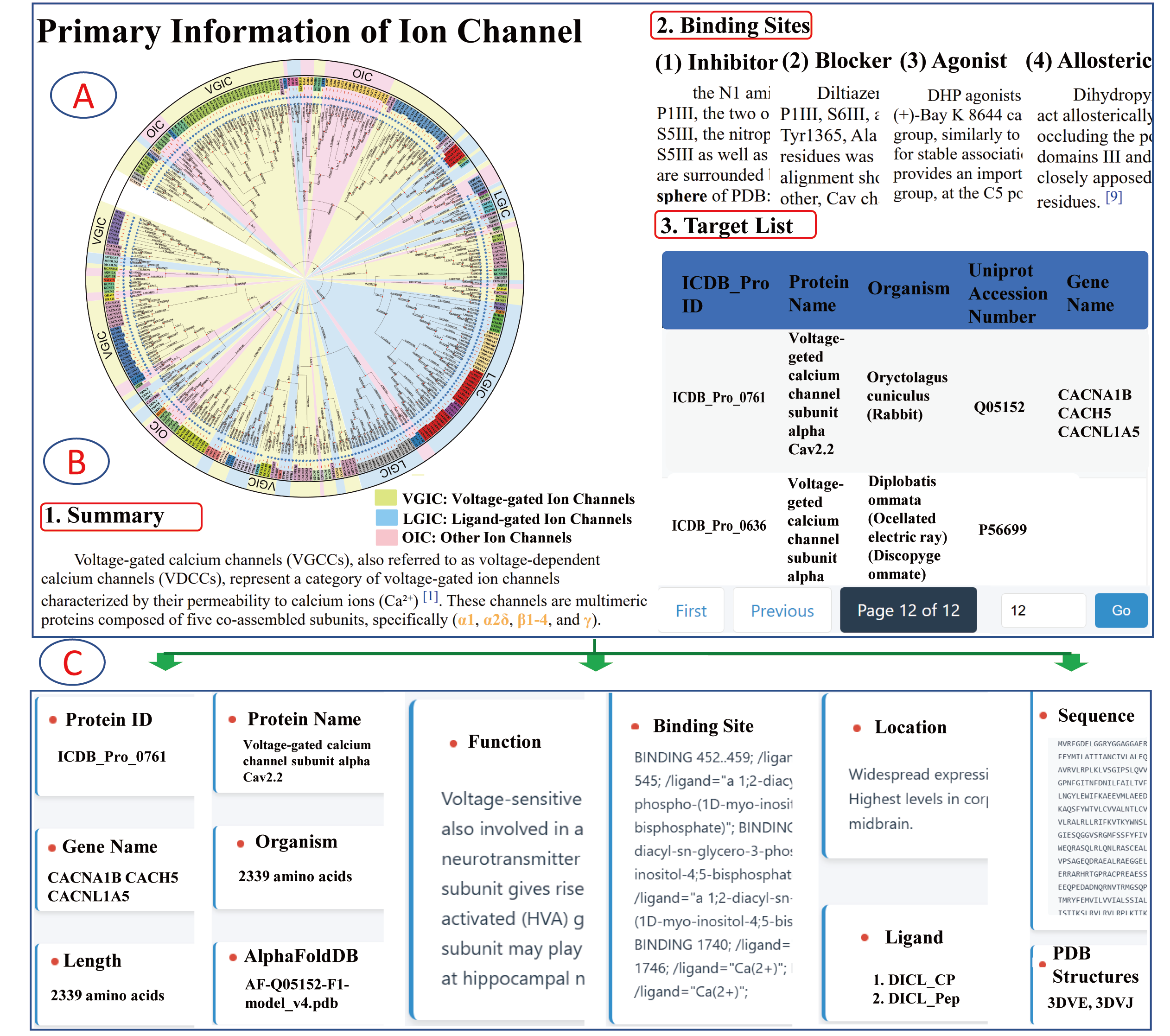
As shown in Figure 5A, , 27 types of ion channels were contained in DICL, including VGKCs, VGCCs, VGSCs, γ-GABA-ARs, nAChRs, i-GluRs, Acid-Sensing Ion Channels (ASICs), 5-hydroxytryptamine type-3 receptor (5-HT3R), ENaC, TPC, VGHC, Ryanodine receptor (RyR), CNG, Chloride channels, Orai channels, Piezo, GJ channel, AQPs, Glycine receptors (GlyRs), KCa, K2P, Kir, Inositol 1,4,5-trisphosphate receptors (IP3Rs), TRP, and Cation channel sperm-associated proteins. These channels are categorized into three groups: voltage-gated (light yellow), ligand-gated (light blue), and other ion channels (light red). The summarized information page of the protein (Figure 5B) serves as the primary repository for protein information in DICL. This page is organized into three distinct sections: Summary, Binding Sites, and Target List. The three-dimensional structure of the protein is displayed in an interactive window, enabling users to rotate and zoom the model. The Binding Sites section is categorized into four classifications according to the function of ligands, namely inhibitor, agonist, blocker, and allosteric modulator. DICL ID, Protein Name, Gene name, Organism, and the UniProt accession number are provided in the Target List. Users can click on the ICDB_Pro ID to access the detailed information page (shown in Figure 5C). This page also offers the detailed information regarding the source, sequence, location, function, related disease, the PDB ID, and organism, thereby facilitating users to understand the involved ion channel quickly.
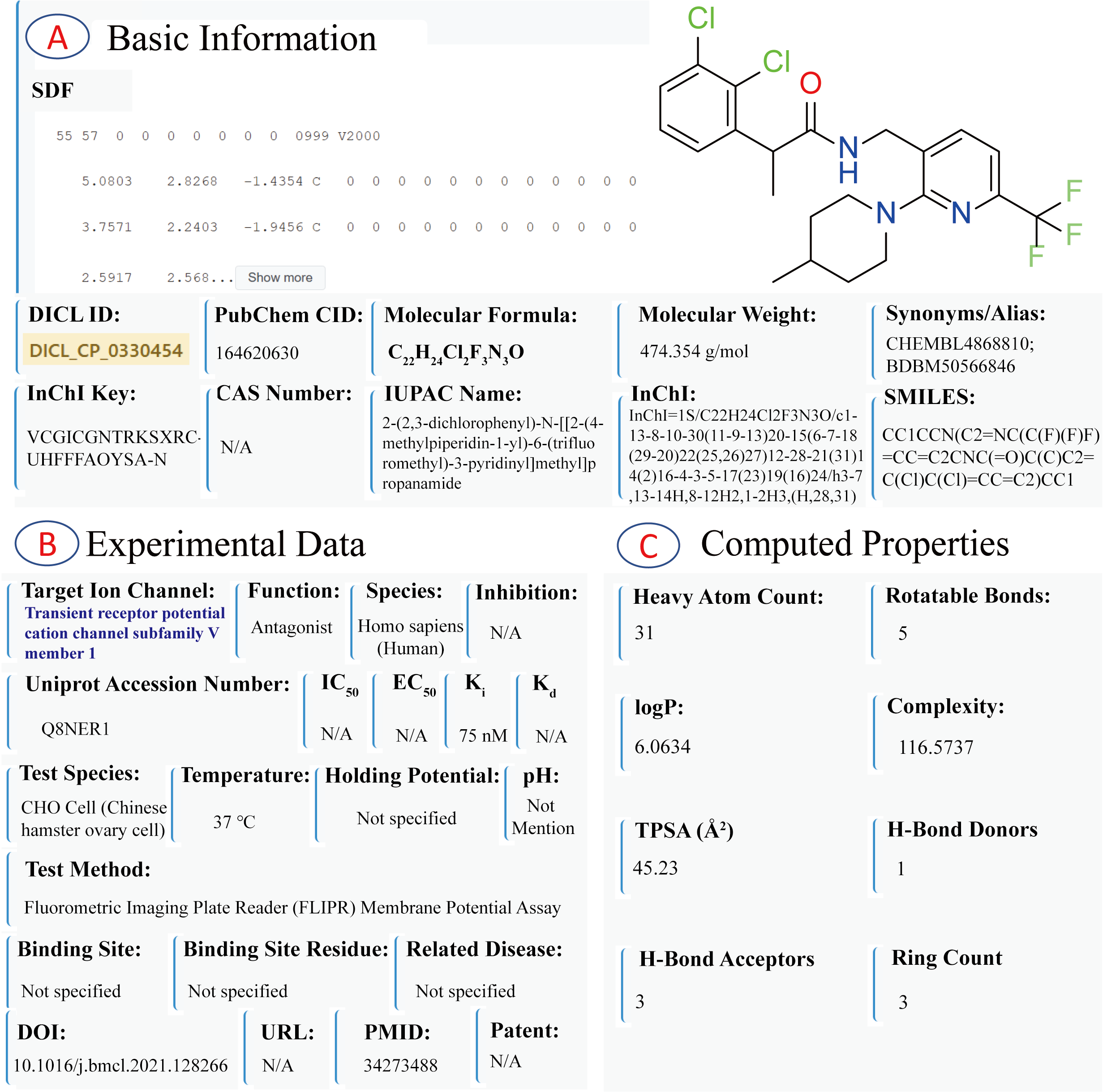
Users can readily access essential compound information and click on the 'DICL ID' to navigate to the dedicated detail page, which provides comprehensive data and properties for the selected compound. The detailed page of a compound contains three sections: Basic Information (Figure 6A), Experimental Data (Figure 6B) and Computed Properties (Figure 6C). The Basic Information section presents detailed data about compounds, including the SMILES, IUPAC name, target, InChI, and more. The Experimental Data section includes PubChem CID, MW, IC50/EC50/Ki/Kd values, organism, binding site, and article PMID or DOI. Additionally, we utilized ADMETlab3.0 and RDKit to calculate the properties of compounds, which are displayed in the Calculated Properties section. The detailed page for peptides only contains Basic Information and Experimental Data, in contrast to the detailed page of compounds.
5. Search & Manual & Download
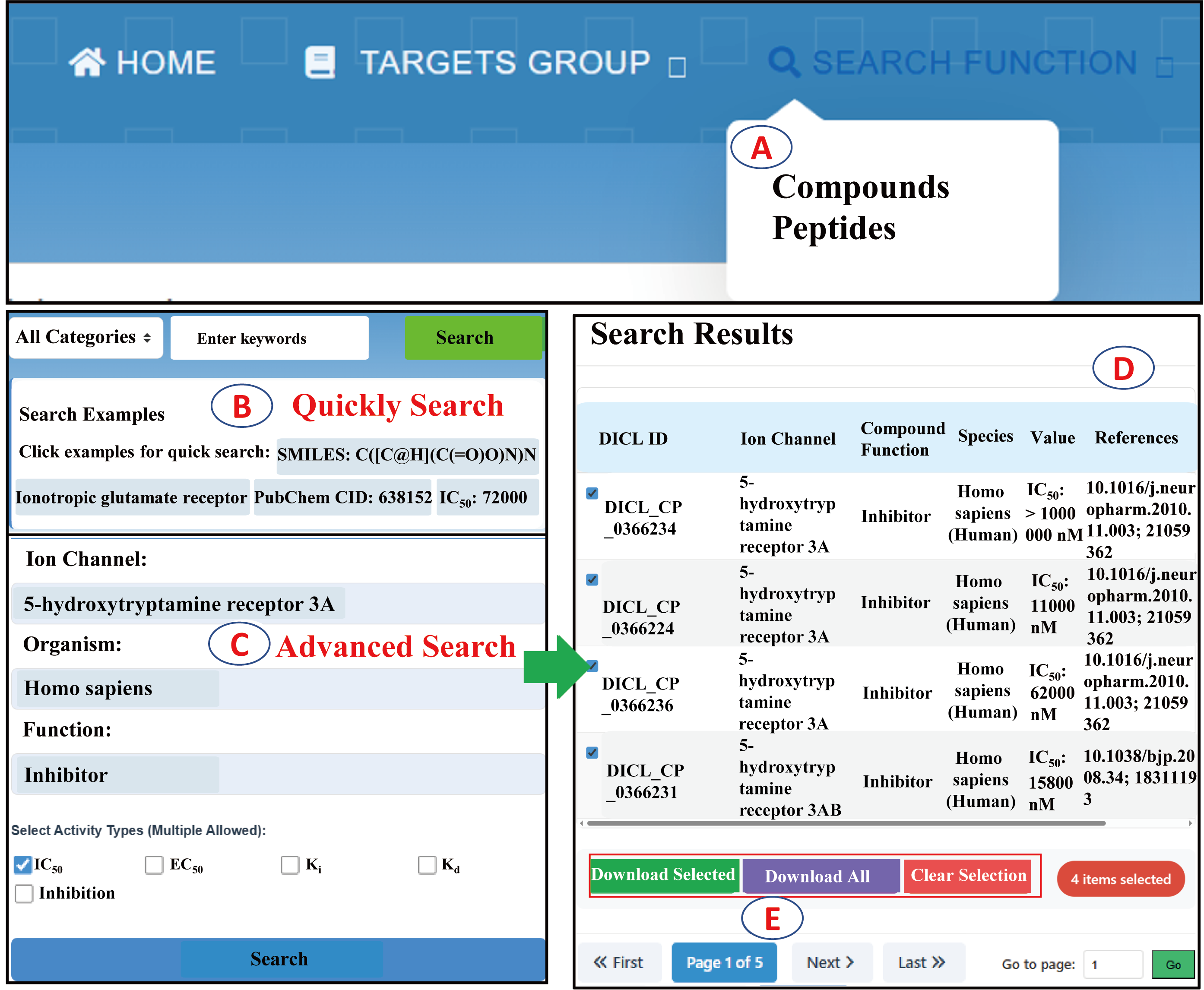
DICL offers users a search (Figure 7A) function for retrieving information on compounds and peptides. DICL offers users a quick (Figure 7B) and advanced search (Figure 7C) function for retrieving information on compounds and peptides. Users can search for compounds by entering keywords such as the "SMILES", "IUPAC name", "The Name of Ion Channel", "DOI", "PubChem CID", "PMID", "Organism", and "DICL ID". The DICL ID functions as a unique identifier within the database for ligands targeting ion channels. Additionally, users can select one or more keywords from options such as ion channel name, organism, function, Ki, EC50, IC50 and Kd as well as the keywords to perform an advanced search. Upon completion of the search, users are redirected to a results page that displays the DICL ID, Ion Channel, Compound function, Species, Compound Activity, and References (Figure 7D).
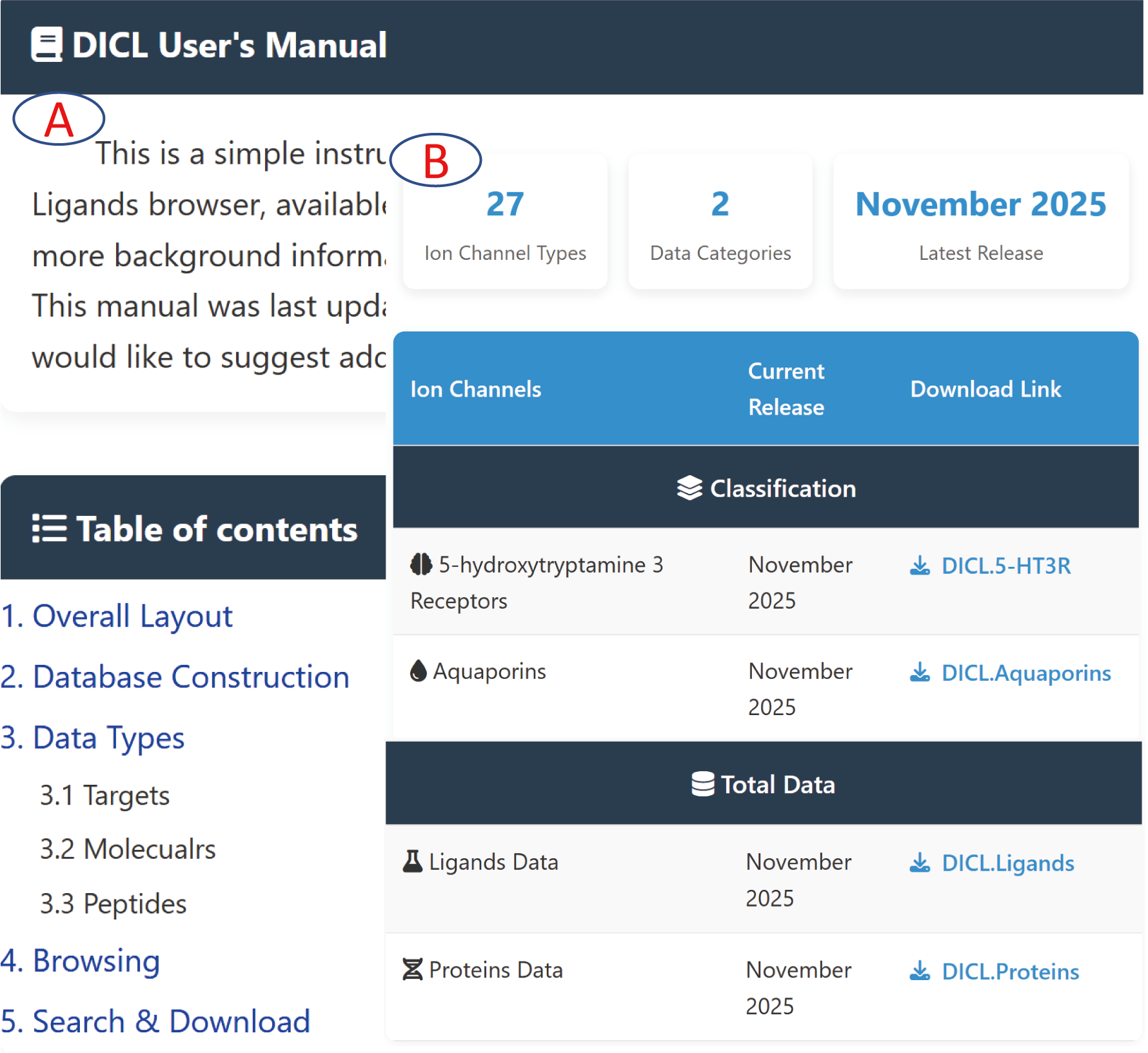
The ‘Manual’ page provides a step-by-step tutorial for users on how to manipulate, query, and browse the database (Figure 8A). It is essential to acknowledge that the collections in DICL do not encompass all data related to ion channels. As shown in Figure 7E, users can select one or more query results to download in batch in CSV file format. Furthermore, user could directly download the ligand information for specific target or all targets (Figure 8B) by click the 'Download Link'.